THE NATIONAL LOTTERY
THE IN'S AND OUTS THE ODDS AND THE STATISTICS
WITHIN THESE PAGES WE HOPE GET THE FINGER OF FATE POINTING AT YOU
This page explains the statistics and how to work out the odds with graphic examples. If you have no interest in this you can skip to the next page. However I would suggest you print a hard copy to read at your leisure to give you a better understanding of how statistics within the National Lottery work, and why I suggest you concentrate on increasing your chances of getting a good return and not chasing the Jackpot prize only.
WITH THANKS TO:
While researching this site I read quite a few books, and visited many websites and web forums. Although trained as an accountant, I was still unaware of how the statistics and odds actually computed. We can be shown the actual odds and information, on many sites but it is my view that unless we know how to achieve them, we cannot not fully understand them, or the effect (or lack) upon our participating. I therefore offer my thanks to all those who have contributed in helping me understand the combinations and comprehend the formula's involved, especially those at the PC Advisor forum.
LENNY LOGO
It may be a little naïve of me to use the lottery logo but I have had many
conversations with people at both the Home Office and Camelot the organisers
of the UK National Lottery and none of them seem to wish to admit possession
or allow restrictions on the copyright. It could be said that I am promoting
their logo but If they ever decide, the ownership and restrictions I will remove
said logo immediately, unless of course they do decide it is doing no harm and
allow me to continue using it ..
Lottery the odds:
For some time I have being trying to study the odds of winning the UK National
Lottery pick any six numbers from forty-nine
There are plenty of sites on the internet that explain the odds but most of
those that I have come across although explain and give examples, use all forms
of mathematic equations, notations, combinatorics, anyone with a degree in maths
will understand these perfectly well, but those of use with no knowledge in
these, find it just a little harder to comprehend.
This is my attempt to explain the combinatorics in plain English using the times
(X) and divide (÷) symbols
To start lets do a simple sum to show the equation. Lets say we have
picked a horse in each of six races on the card. And we want to place a bet
which covers all the combinations of doubles and trebles. The first thing we
need to know is how many doubles. i.e. how many 2's from 6 selections. For the
first selection the odds are we need I from 6 for the second selection assuming
we have the first we need the second from 5 remaining selections to get a double.We
write this down as 1 x 2 divided by 6 x 5 = 2 divided by 30 = 15
Therefore there are a combination of 15 doubles from six selections.
To see how many doubles we have if one of our selections loses it is just a
case of adjusting the equations and saying we have any 2 from 5 i.e. 1 x 2 divided
by 5 x 4 = 2 ÷ 20 = 10. That is 1 from 5 and 2 (the second) from the
4 remaining races. Similarly if two horses lose the equation is adjusted so
we have the 1 from 4 and the second to achieve a double from the remaining 3
races. Hence 1 x 2 ÷ 4 x 3 = 6 doubles. Therefore if all 6 selections
win you have 15 doubles if 5 win 10 doubles if 4 win 6 doubles 3 win you have
just 3 doubles and of course just 2 win you have only the one double.
The trebles are worked out exactly the same way. Assuming you get the first
correct 1 from 6 (the second) 2 from 5 and (the third) 3 from 4 remaining races.
i.e. 1x 2x 3 ÷ 6x 5x 4 = 6 ÷ 120 or 1 over 20 = 20 trebles. Again
we can use the same equation to see how many trebles we have assuming one of
our selections loses, we have 1 from 5 x 2 from 4 x 3 from 3, which is 1 x 2
x 3 ÷ 5 x 4 x 3 = 60 ÷ 6 = 10 trebles or if two lose 1 x 2 x 3
÷ 4 x 3 x 2 = 4 (if you write down as 1 x 2 x 3 over 4 x 3 x 2 you would
cancel the 2 x 3 to leave 1 over 4 avoiding the long multiplication and divisions)
See example ;

NOW THE NATIONAL LOTTERY
This requires us to pick any 6 numbers from a possible 49. The order in which
the numbers are picked is not important; you just have to pick the six numbers.
The same applies for this as does the equation for 2 from 6 or 3 from 6 . i.e.
If you attempt to select just one number from 49 lottery balls then the probability
that you correctly predict are 1 in 49, therefore if you choose six numbers
then the probability that one of your numbers is the same as the first ball
drawn is 6 in 49. Given that the first number is chosen correctly, then the
probability of drawing the second number correctly is 5 in 48. (i.e. there are
48 balls left in the drums and having correctly drawn the first number we have
5 selections left) Given we have the first two numbers the probability of getting
a third is 4 in 47 and so on. 3 in 46, 2 in 45, and 1 in 44. So we write the
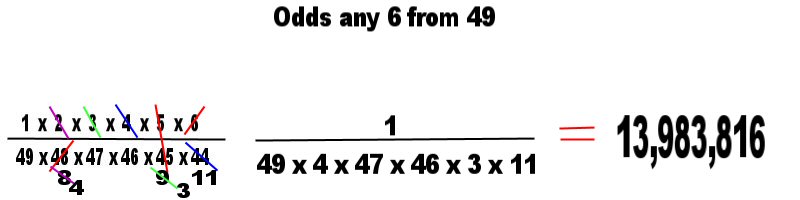
equation out in just the same way: 1 x 2 x 3 x 4 x 5 x 6 (6 selections) over
49 x 48 x 47 x 46 x 45 x 44. After cancelling out cross multiplications we have
the result. The odds of picking all six balls correctly are 1 in 13,983,816.
See the example:-
For the UK lottery we have a chance at the second prize by selecting and additional
ball drawn this being the bonus number. What are the odds of selecting this
number? Well there are 6 combinations of selecting 5 numbers (any 5 from 6 using
our equation) and we have one chance of selecting the extra number, so our chances
become 6 x 1 = 6 so assuming we already have 5 correct the odds of the 7th ball
drawn being one of our selections is 13,983,816 ÷ 6 which gives us odds
of 1 in 2,330,636.
How do we calculate the odds of getting the lower prizes? Well we know the odds
for getting 6 from 49 that's 13,983,816. There are 6 winning numbers so there
are 6 ways to select 1 out of 6. We know there are 43 numbers that don't win
and using our equation we can determine that there are 962,596 ways to select
5 out of 43 numbers that don't win. We can then multiply by 6 and determine
that there are 5,775,588 ways to select 6 from 49 with one that is a winning
selection, divide this by the odds of (6_49) (i.e. 13,983,816) and we have odds
of 0.41301945 or 2.42 to one.
Similarly the odds to select two correct are therefore (2_6) x (4_43) ÷
(6_49) which equals 1,851,150 ÷ 13,983,816 = 0.13237802 or 1 in 7.5
Three winning numbers are (3_6) x (3_43) ÷ (6_49) which equals 246,820
÷ 13,983,816 = 0.01765040 or 1 in 57
Four winning numbers are (4_6) x (2_43) ÷ (6_49) = 13,545 ÷ 13,983,816
= 0.00096819 or 1 in 1,033
Five winning numbers are (5_6) x (1_43) ÷ (6_49) = 258 ÷ 13,983,816
= 0.00001844989 or 1 in 54,201
Euro Millions.
The lottery organisers make no secret of the odds of winning, in fact I think
that under the law they are obliged to publish the odds. Winning the Euro millions
jackpot is a staggering 76 million to one, they don't publish how they arrive
at the figure but the calculation is easy to explain using our above formula.
The game requires we select 5 number from 50 and then select a further 2 balls
from 9 star balls from another machine so we have a formula:- (5_50) x (2_9)
which is exactly the same as saying (1 x 2 x 3 x 4 x 5 ÷ 50 x 49 x 48
x 47 x 46) x (1 x 2 ÷ 9 x 8) = 2,118,760 x 36 = 76,275,360. This is a
popular formula for many of the big super State Lotteries in the United States,
however they tend to use pick 5 from 50 and then just one star ball from 36,
from the second machine. As you can see, the odds for the second machine are
the same, as to select any 2 from 9 (2_9) is 36 to 1.
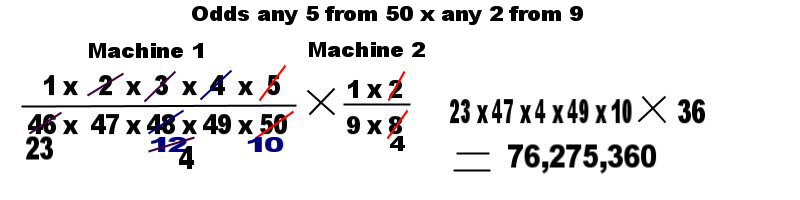
So for Euro Millions we have 2 machines and 2 formula to multiply to find the
odds. i.e for lower prizes we have to calculate the odds of getting 1,2,3,4,or
5 correct and then multiply these odds by the probability of getting either
1 or 2 from the second machine. Working out the odds for 4 from the 50 is the
same as explained for the National Lottery and then we just multiply by the
second machine.
The probability of getting just one Star Ball is explained by the probability
of getting the first is 2 from 9 = 36 to 1, assuming we do not have the first
ball then the odds of the second ball being drawn is equal to 7 in 8, there
are now only 8 balls left and there are seven that we don't have. So the odds
are 7 in 18 = 2.5714. That is to say that the probability of getting the first
Star ball without the second is 7 in 36 and the probability of not getting the
first Star ball but getting the second is also 7 in 36. So to find the probability
that we get one of these occurrences we just add the individual probabilities
= 7/36 + 7/36 = 7/18 therefore the odds of getting 5 from the first machine
with just one from the second is (5_50) = 2,118,760 x 18 ÷ 7 which is
5,448,240 to 1. exactly as the organisers state. If we divide the jackpot odds
76,275,360 by this we note that your chances of getting just 1 Star ball is
14 times greater than hitting the jackpot, this shows the odds to be correct,
if there are 36 possible ways of choosing any 2 balls from nine in any order
without replacing them back in the drum, then 14 of these ways will satisfy
our requirements of matching just one star ball.
So the chances of winning the jackpot in the National Lottery are extremely
high, and if we look at the Euro Millions the odds are more than 5 times greater
still, so what do we do. Does the odds against us winning mean that the best
strategy is not to play at all? Well the optimal strategy is to play, if you
do not play you will never win, you have zero chance, which is entirely different
to having a small wager and having a non zero chance. As my dad used to say
"you've got to be in it to win it", and which other game gives you
the chance of winning a few million pounds for a £1.00 stake. In my view
the best way to play the lottery is to forget about winning the jackpot but
play a strategy to reduce the odds against winning the smaller prizes that way
you get an increased chance of winning something and still have chance of getting
the jackpot, or one of the larger prizes. Don't forget whatever selection of
numbers you stake your wager on each set has the same chance of winning the
jackpot.
So now you want to know how to increase those odds. Browse to the next
page and I will tell you how.

If you have any comments or would like to contact me click on the bottle